Summarize this article:
 1819 Learners
Last updated on December 16, 2025
Factors of 18


What are the Factors of 18
The numbers that can be multiplied together in pairs to give the product 18 are its factors. The factors of 18 are 1, 2, 3, 6, 9, 18. Number 18 has 6 factors in total.
Negative Factors: These are negative counterparts of the positive factors of 18
Negative factors: -1, -2, -3, -6, -9, -18
Prime Factors: These are the prime numbers when multiplied together give the product 18.
Prime Factors: 2, 3
Prime Factorization: Prime factorization involves breaking the number into its prime factors
It is expressed as 2 x 32
sum of the factors:The sum refers to the number we get by adding the factors of the given number.
Sum = add all the factors of 18
Sum = 1+2+3+6+9+18 = 39
The factors of 48 can be written as shown in the table given below:
| Factor Type | Values |
| Positive Factors | 1, 2, 3, 6, 9, 18 |
| Negative Factors | -1, -2, -3, -6, -9, -18 |
| Prime Factors | 2, 3 |
| Prime Factorization | 2 × 32 |
| The sum of the Factors | 39 |
How to Find the Factors of 18
The factors can be found using different methods. These make sure that the factors obtained are correct.
Method to find the factors of 18:
- Multiplication Method
- Division Method
- Prime Factor and Prime Factorization
Finding Factors Using Multiplication Method
The multiplication method finds the pair of factors that give 18 as their product. Here is the step-by-step process:
Step 1: Find the pair of numbers whose product is 18.
Step 2: The factors are those numbers, when multiplied, give 18.
Step 3: Make a list showing the multiplication process.
1 × 18= 18
2 × 9 = 18
3 × 6 = 18

So the factors of 18 are 1, 2, 3, 6, 9, 18.
Explore Our Programs


Finding Factors Using Division Method
The division method finds the numbers that fully divide the given number.
Step-by-step process in division method:
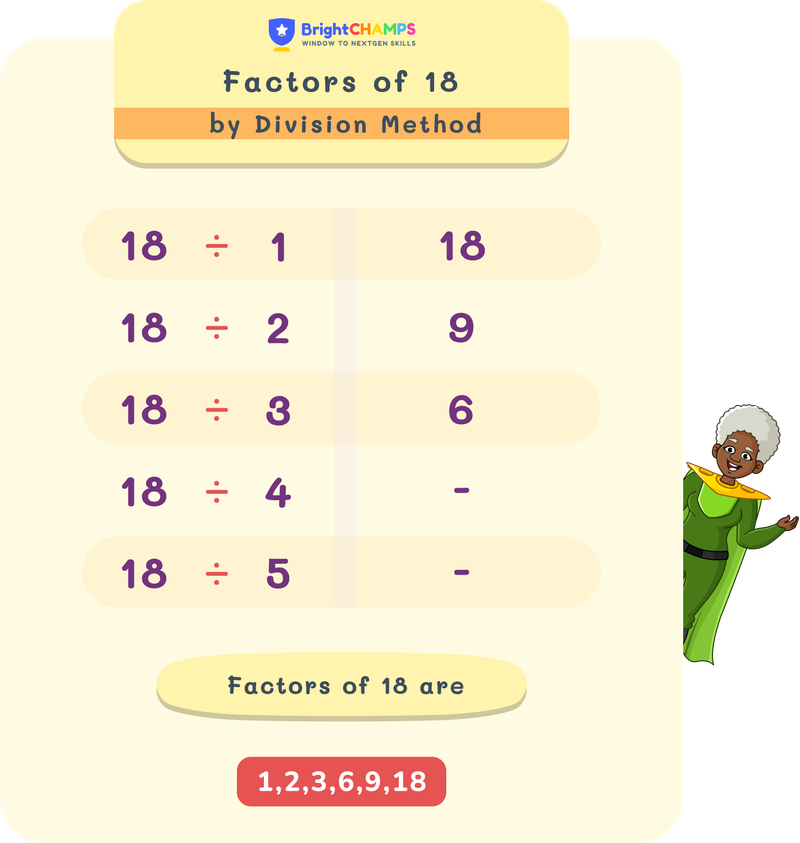
Step 1: Since every number is divisible by 1, always start your division with 1. Both 1 and the number will always be its factors. Example: 18÷1 = 18
Step 2: Take the next number and see if the number is divided completely. Both divisor and quotient are the factors.
Example: 18÷2 = 9, 18÷3 = 6, and so on. Here, 2 and 3 are the divisors and, 9 and 6 are the quotient.
Step 3: Stop dividing once you divide 18 by 18 giving 1 as the factor. We cannot divide 18 with numbers greater than 18.
Overview of factors of 18 using the division method:
Prime Factors and Factorization
- Multiplying prime numbers to get the given number as their product is called prime factors.
- Prime factorization is the process of breaking down the number into its prime factors.
Prime Factors of 18
Number 18 has only two prime factors
The prime factors of 18 are 2 and 3.
Steps to find the prime factors of 18:
Step 1: Divide 18 with the smallest prime number 2
18÷2 = 9
Step 2: Take the next prime number, which is 3
9÷3 = 3
3÷3 = 1
Prime Factorization of 18
Prime Factorization breaks down the prime factors of 18
The Prime Factorization of 18 is expressed as 2 x 32
Factor Tree
Factor tree visually represents the prime factorization. It helps to understand the process easily.
The prime factors of 18 can be found using the factor tree
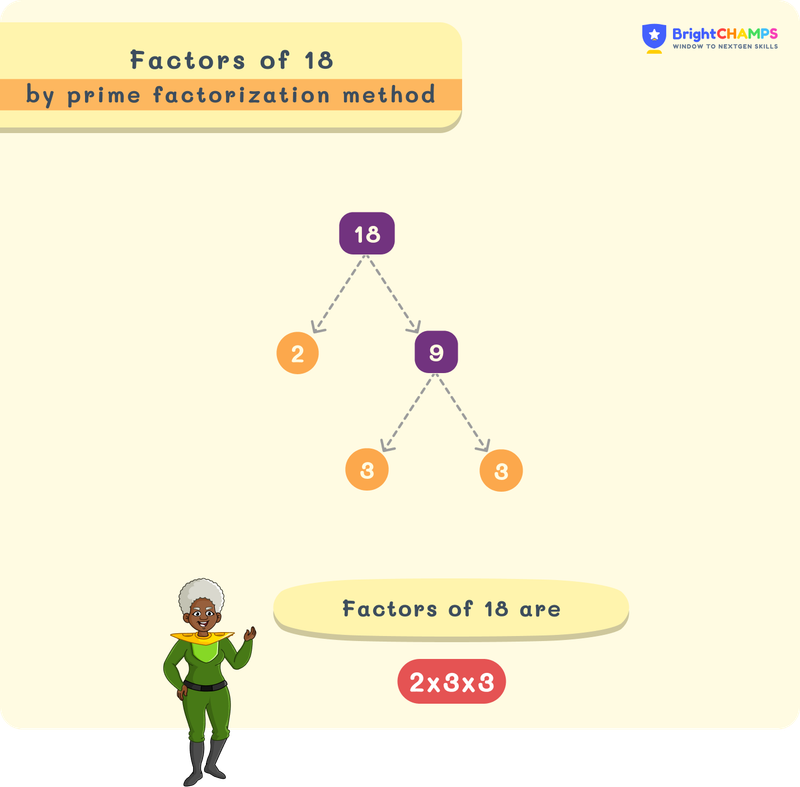
Step 1: Split 18 into two factors, 2 and 9
Step 2: Split 9 into factors, 3 and 3
Step 3: Split 3 into two factors, 1 and 1.
Factor Pairs of 42
The factors of 42 can be written in both positive and negative pairs. The table below represents the factor pairs of 42, where the product of each pair of numbers is equal to 42.
Positive Pair Factors of 42:
| Factors | Positive Pair Factors |
| 1 × 42 = 42 | 1, 42 |
| 2 × 21 = 42 | 2, 21 |
| 3 × 14 = 42 | 3, 14 |
| 6 × 7 = 42 | 6, 7 |
Since the product of two negative numbers is also positive, 42 also has negative pair factors.
Negative Pair Factors of 42:
| Factors | Negative Pair Factors |
| −1 × −42 = 42 | −1, −42 |
| −2 × −21 = 42 | −2, −21 |
| −3 × −14 = 42 | −3, −14 |
| −6 × −7 = 42 | −6, −7 |

Common Mistakes and How to Avoid Them in Factors of 18
Mistakes can occur while finding the factors. Learn about the common mistakes that can occur. Solutions to solve the common mistakes are given below.
Mistake 1

Identifying 18 as a perfect square of 9

9 is the perfect square of 81. Always go for a re-check of the factors.
Mistake 2
Not checking for higher factors
Start dividing 18 using each factor until you get the quotient as 1. Factors won’t be higher than 18.
Mistake 3
Omitting the factor pairs of 18
Factor pairs when multiplied together give 18. Check for numbers whose product will be 18
Mistake 4
Getting confused with exponents and factors
The numbers written as superscripts are its exponents and not the factors of 18
Mistake 5
Not using a factor tree to find the prime factors
Using a factor tree for numbers like 18 will make it easy to identify the prime factors.



Examples on Factors of 18


Problem 1
Find the common factors in 18 and 12

The common factors are 1, 2, 3 and 6
Explanation
List the factors of 18 and 12
Factors of 18: 1, 2, 3, 6, 9, and 18
Factors of 12: 1, 2, 3, 4, 6 and 12
Filter out the common factors: 1, 2, 3, and 6

Problem 2
What will be the product of all the odd factors?
The product of all the factors of 18 is 27
Explanation
List out the factors of 18
The factors of 18 are 1, 2, 3, 6, 9, 18
Now multiply the odd factors: 1 × 3 × 9= 27
Problem 3
A family in Chicago buys 18 juice boxes from Target to pack for a school event. They want to divide the juice boxes equally among groups so that no juice box is left over. What are all the possible group sizes they can choose?
1, 2, 3, 6, 9, 18
Explanation
To divide the juice boxes equally without leftovers, the number of groups must be a factor of 18.
Any number that divides 18 exactly is a valid group size.
The factors of 18 are 1, 2, 3, 6, 9, and 18, so these are all the possible group sizes.
Problem 4
An NBA youth basketball clinic in Los Angeles (LA) has 18 players attending practice. The coach wants to split the players into equal teams for drills. Which team sizes are possible?
1, 2, 3, 6, 9, 18
Explanation
Equal teams mean the total number of players must be divided evenly.
So, the possible team sizes must be factors of 18.
Since 18 can be divided exactly by 1, 2, 3, 6, 9, and 18, all of these team sizes are possible for practice.
Problem 5
A CVS pharmacy in New York City receives a medicine pack containing 18 tablets. The pharmacist needs to organize the tablets into equal daily doses so that each dose has the same number of tablets. How many tablets can be in each dose?
1, 2, 3, 6, 9, 18
Explanation
To create equal doses, the number of tablets per dose must divide 18 evenly.
That means the dose size must be a factor of 18.
The factors of 18 are 1, 2, 3, 6, 9, and 18, so these are all the possible tablets per dose.

FAQs on Factors of 18
1.Can 18 have negative factors?

2.Name a simple method to determine the factors of 18
3.Identify the perfect square factor of 18.
4.What is the importance of the factors?
5.How many factor pairs does 18 have?
6.How many factors does 18 have?
7.What is the smallest factor of 18?
8.What is the largest factor of 18?
9.Which factors of 18 add up to 13?
10.How many even factors does 18 have?
11.What are the odd factors of 18?
12.What is the sum of all the factors of 18?
Important Terms Related to Factors of 18
Factors: Factors are those numbers that divide the given number without leaving no remainder.
Prime Factorization: The prime factorization of numbers involves breaking them down into their prime factors.
Prime factors: These are the prime numbers that multiply together to form a given number
Composite number: Number that has at least more than one divisor other than 1 and the number itself.
Greatest Common Factor: The largest integer that divides two or more integers without any remainder.
More topics related to Factors of 18

![Important Math Links Icon]() Other topics in Factors
Other topics in Factors
![Important Math Links Icon]() Explore More Numbers Topics
Explore More Numbers Topics
![Important Math Links Icon]() Numbers category quick links
Numbers category quick links



Samia
About the Author
Samia has almost two years of teaching experience. She is a number ninja as she loves numbers. Her interest in numbers can be seen in the way she cracks math puzzles and hidden patterns.
Fun Fact
: She loves to read number jokes and games.


We use cookies for essential site function, analytics, and marketing. You can accept all, reject non-essential cookies, or customize your choices. See our Cookie Policy.