




Summarize this article:
 583 Learners
Last updated on December 10, 2025
Less Than

In mathematics, if one number is smaller than another, we use the symbol “<” to describe their relationship. For example, two friends received their scorecards, and one child scored 25 marks, which is less than another student’s score of 30. In this topic, we will learn about the less than sign and its importance.

What is Less Than in Math?
We compare numbers to understand which is greater, smaller, or equal. In mathematics, the less than (<) symbol is used to show which number or quantity is smaller than the other. The “<” symbol explains that the value on the left side of the sign is smaller than the value on the right side.
For example, 4 < 5 means that 4 is less than 5. Since it compares two numbers or quantities, the less than symbol is known as a binary operator because it compares two values. The other common comparison symbols are greater than (>) and equal to (=).
Comparison Symbols – Less Than, Greater Than, and Equal to
In mathematics, we use three main symbols to compare numbers and quantities. By using these symbols, we can easily understand which one is smaller than, greater than, or equal to another.
| Features | Less than | Greater than | Equal to |
| Symbol | (<) | (>) | (=) |
| Meaning | The value on the left side is smaller than the value on the right. | The value on the left side is greater than the value on the right. | The values on both sides are equal. |
| Example | 3 < 6 | 9 > 7 | 3 = 3 |
How to Use the Less Than Sign?
Let’s learn how to use the less than sign by comparing two numbers: 34 and 18.
To begin, we have to identify the place values of the given numbers. When the given numbers have the same tens digit, move on to the ones digit.
Identify which number is less than the other and use the symbol “<”. When placing the symbol, make sure the pointed end faces the smaller number and the wide-open side of the sign faces the larger number.
Here, we can compare the tens digit of the given two numbers: 34 and 18.
As we know, 1 is smaller than 3.
Hence, 18 is less than 34. It can be written as 18 < 34.
Explore Our Programs


Less Than Symbol on Number Line
We can visually understand the less-than symbol by placing the numbers on a number line. A number line provides a clear visual that shows how values relate to each other.
Let us try to understand this with an example.
x < 4. This inequality states that x can take any value less than 4. On a number line, we can represent this by shading the part to the left of 4, as shown in the image below.
Less Than or Equal on Number Line
We use the less-than-or-equal-to symbol to define a range with a maximum limit. It helps us identify how big or small a number can be.
Let us try to understand this with an example.
x ≤ 4. This inequality states that the value is either 4 or less than 4. On a number line, we can represent this by shading the region to the left of 4 and the area where the number is present, as shown in the image below.
Not Less Than Symbol
We use the not less than symbol (≮ ) when the quantity on the left side is not less than the quantity on the right side. This states that the amount on the left is greater than the quantity on the right.
For example, let us say that Akhtar is x years old and Akshay is y years old. Akshay is older than Akhtar, so Akshay's age is not less than Akhtar's. We can mathematically represent this as y ≮ x.
Less Than Greater Than
The phrase “less than” means that the value on the left side is smaller than the value on the right side. It is written using the symbol “<”. When we reverse this symbol, it becomes “>”, which symbolizes the “greater than” symbol in mathematics. “Greater than” means that the value on the left side is larger than the value on the right side and is the opposite of “less than.”
When drawing a less-than sign, the open side faces the larger number, and the pointed tip faces the smaller number. For example, 5 < 6 means five is less than 6, and 6 > 5 means six is greater than 5.
Tips and Tricks to Master Less Than Sign
When we use the less than sign, we need to keep in mind some tricks to apply it properly. The signs of less than and greater than look similar, but have different meanings. Here are two tricks to help you remember the less than sign: the L method and the smaller mouth method.
- L method: This trick is based on the first letter of the word, “less,” and the letter L looks similar to the “<” sign. By remembering this trick, we can use the less than sign “<” correctly.

- Closed mouth method: The pointed end of “<” faces the smaller number, and the wide end faces the larger number.

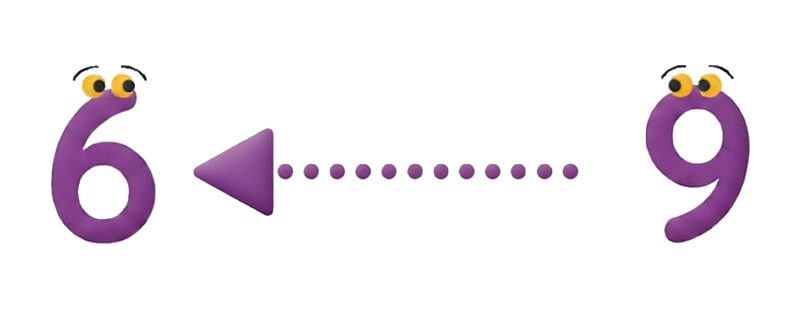
- Arrow method: The symbol can be resembled with the end of an arrow. The arrow is drawn from the larger quantity towards the smaller quantity.
- Alligator Mouth: Assume the symbol as an alligator's mouth, since the alligator always eats bigger objects, the number at the open mouth side will be larger.

- Finger Trick: Extend your index finder and thumb while keeping all the fingers in a fist. The shape formed resembles a less than sign. The number at the open fingers is a larger number, whereas the number at the narrow end in smaller.
- Teachers can use visual supports, such as a number line, to help learners see that numbers on the left are less and those on the right are more.
- Parents should encourage their children to draw arrows or hops on the number line to show the movement from a smaller number to a larger one, showing that the number on the left is less.
- Parents can make use of everyday objects to casually ask their children to identify “Which is less?” and then connect it back to the symbol. We can use objects like items in a shopping basket, or snacks and toys.
- Teachers can ask learners to physically move concrete objects to match and compare ideas of 'more' and 'less'.

Common Mistakes and How to Avoid Them on Less Than
Students may get confused and make errors when they work with the less than symbol and the concept. Here are some common mistakes and their solutions to prevent such errors.
Mistake 1

Confusion Between “<” and “>” Signs

Remember that the less than is indicated by the sign “<”, while the greater than is represented by “>”. The value on the left side of the “<” is smaller than the value on the right side. Similarly, the value on the left side of the “>” is larger than the value on the right side.
For example, 8 < 10 shows that 8 is less than 10.
9 > 2 explains that 9 is greater than 2.
Mistake 2
Forgetting to Check Different Units
The values are given in different units, like meters, centimeters, or kilometers, convert all units to the same unit before comparing. It is difficult to compare one unit in meters and another in kilometers.
For example, if students conclude that 100 cm < 1 m, it is incorrect. The correct comparison is 100 cm = 1 m.
Mistake 3
Assuming the signs (<) and (≤) are the Same
Keep in mind that less than is represented by the symbol “<” and less than or equal to is expressed by “≤”. If students mistakenly assume both the signs are the same, they will get incorrect conclusions.
For instance, an athlete must finish the race in < 30 seconds to crack the record, which means he fails if he finishes the race in exactly 30 seconds.
However, if an athlete must finish the race ≤ 30 seconds to crack the record, it means he needs to complete it in 30 seconds or less than 30 seconds.
Mistake 4
Ignoring the Criteria of Negative Numbers
Be careful when comparing negative numbers, and remember the concept of absolute value. Among negative numbers, a number with a larger absolute value is smaller. For example, -10 < -5.
For example, -10 is less than -5 (-10 < -5). The absolute value is the distance between the number and zero. Here, the absolute value of -10 is 10, and -5 is 5.
Mistake 5
Mistakenly Comparing Decimals and Fractions
When comparing decimal and fractional values, always remember to convert the decimals to fractions or use a number line.
For example, It is incorrect to write 0.6 < 0.55. The correct comparison is 0.55 < 0.6, which means 0.55 is less than 0.6.

Real-Life Applications of Less Than
We often compare numbers, values, measurements and distances in our everyday life. Also, we use the less than symbol and concept to identify the lesser values among others. Here are some real-life applications of less than:
- Shopping: Less than is used to compare the prices of different items with an estimated budget. It helps to choose and purchase affordable products from the store. For example, if an outfit costs $15, and you have $12, you can’t buy it because $12 < $15.
- Travelling: While driving, you must compare your speed with the maximum speed limit set by the authorities to ensure safety. Example: If you are driving at a speed of 45 km/h, and the speed limit is 50 km/h, then you can see that your driving speed is less than the speed limit, and you are following the traffic rules.
- Academics: By this “less than” concept, you can evaluate academic performance and identify areas of improvement. For example, if you scored 55 marks in a subject, and the cutoff is 60. This means you scored less than the pass mark, so you need to improve your academic performance.
- Cooking: When you cook, it is important to add ingredients in the required amounts to ensure the food tastes good. Using too much or too little of an ingredient can affect the taste of the food. For example, if you add 1 teaspoon of salt to a recipe and the required amount of salt is 2 teaspoons, this means you used less than the required amount of salt.
- Calculating Time: Less than can be used to find a duration which is shorter than a certain amount of time. Example; if a runner has to complete one round in 30 minutes, and 25 minutes have already passed, then he/she has to complete the round in less than 5 minutes., to reach the goal before the time limit.



Solved Examples of Less Than


Problem 1
How much less is 30 cm than 56.7 cm?

30 cm is 26.7 cm less than 56.7 cm
Explanation
Here, we have two numbers to compare. So, we need to find out how much less 30 cm is compared to 56.7 cm.
Since 30 cm is less than 56.7 cm,
We subtract the small value from the large value.
56.7 - 30 = 26.7
Hence, the answer is that 30 cm is 26.7 cm less than 56.7 cm.

Problem 2
Sam and Vincent have fruit baskets. Sam has 25 mangoes, while Vincent has 22 mangoes. Who has fewer mangoes?
Vincent has fewer mangoes than Sam.
Explanation
Sam has 25 mangoes.
Vincent has 22 mangoes.
To know who has fewer mangoes, we need to compare the number of mangoes both of them have.
Compared to Sam, who has 25 mangoes, Vincent has 22.
22 is less than 25.
It can be written as:
22 < 25.
Hence, Vincent has 22 mangoes, which is less than Sam’s 25 mangoes.
Problem 3
Mary read 45 pages of a book, while her brother read 50 pages. Who read fewer pages?
Mary read fewer pages than her brother.
Explanation
Mary read = 45 pages
Brother read = 50 pages
To find out who reads fewer pages, we compare both the numbers.
Since 45 is less than 50, Mary read fewer pages than her brother.
Problem 4
Tinto and Roy love candies. Tinto has 40 candies, while Roy has 35 candies. Who has fewer candies?
Roy has fewer candies.
Explanation
First, we can start listing the number of candies each of them has.
Tinto = 40 candies
Roy = 35 candies
Now, compare the two numbers:
35 < 40
Hence, Roy has fewer candies than Tinto because 35 is less than 40.
Problem 5
In CMS School, there are two sections: Fiction and Non-Fiction. The Fiction section has 150 books, and the Non-Fiction section has 85 books. Which section has fewer books?
The non-fiction section has fewer books
Explanation
To find out which section has fewer books, first identify how many books are in each section.
Fiction section = 150 books
Non-fiction section = 85 books
Now, we can compare the two numbers:
85 < 150
This shows that 85 is less than 150, so the non-fiction section has fewer books in CMS School.

FAQs on Less Than
1.How to explain "Less than" to my child?

2.How to explain difference between “less than” and “greater than” to my child?
3.How do I explain to my child that negative numbers are less than zero?
4.Are “less than” and “less than or equal to” the same?
5.How can I explain to my child that 5 is less than 3?

Hiralee Lalitkumar Makwana
About the Author
Hiralee Lalitkumar Makwana has almost two years of teaching experience. She is a number ninja as she loves numbers. Her interest in numbers can be seen in the way she cracks math puzzles and hidden patterns.
Fun Fact
: She loves to read number jokes and games.


