




Summarize this article:
 1183 Learners
Last updated on November 16, 2025
Multiplication

Multiplication is a method used for fast counting. It helps you quickly find out the totals for a bunch of things, for example say you are buying 10 candy and the price of each candy is $1, then the total is 10 candy × $1 = $10.

What is Multiplication in Math?
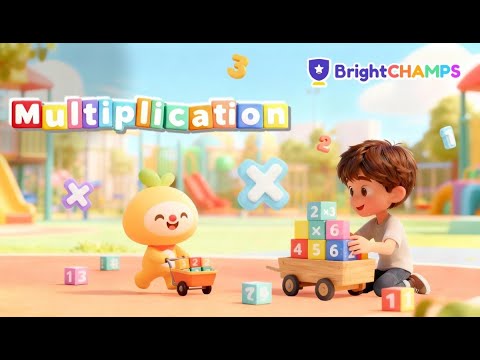
Multiplication is one of the four fundamental mathematical operations, along with addition, subtraction, and division. Multiplication is the process of calculating the product of two or more numbers in mathematics.
- Repeated Addition: Multiplication is essentially a shortcut for repeated addition. For example, $4 × 4 = $16 is the same as adding $4 to itself four times: $4 + $4 + $4 + $4 = $16.
- Parts of a Multiplication: When multiplying, the numbers involved have specific names. In the equation, 15 × 2 = 30:
- 15 is the multiplicand (the number being multiplied).
- 2 is the multiplier (the number of times the multiplicand is added).
- 30 is the product (the result of the multiplication).
- 15 is the multiplicand (the number being multiplied).
- Multiplication Symbol/Sign: The most common multiplication symbol, or multiplication sign, used are the cross (×), the asterisk (*), or a dot (.).
The history of multiplication begins with the Babylonians, who were the first to use multiplication tables written on clay tablets. The later Egyptians and Greeks created the first formulaic algorithms. Around the 12th century, the Indians made significant progress by developing the lattice method, a system that uses grids to make calculations simpler. These algorithms were considerably simpler to use when Fibonacci's Hindu-Arabic numeral system was later widely adopted in Europe. The modern education now emphasizes strategies like long multiplication and the use of a multiplication chart, in order to help students learn their facts and acquire multiplication by heart.
Properties of Multiplication
When learning multiplication we should understand the basic properties of multiplication, such as associative, commutative, identity, and distributive property.
- Associative property: The grouping of numbers when multiplying doesn't affect the product. Such as (2 × 3) × 5 = 2 × (3 × 5) = 30
- Commutative property: The order of the numbers when multiplying won’t change the result. That is 5 × 7 × 6 = 6 × 7 × 5 = 210
- Identity property: The product of multiplying a number with 1 will always be the number itself. That is 5 × 1 = 5; 456 × 1 = 456.
- Distributive property: The product of multiplying a number with any addends will be the same when we multiply the number with each addend separately and add it. Such as 2 × (5 + 2) = 14 and (2 × 5) + (2 × 2) = 10 + 4 = 14.
Types of Multiplication
There are types of multiplication based on the digits of multiplicand and multiplier, the type of number we multiply. A few of the types of multiplication are:
- Single-digit Multiplication: Single-digit multiplication is the multiplication of single-digit numbers.
That is 5 × 6 = 30.
- Multi-digit Multiplication: The multiplication of two or more digit numbers is known as multi-digit multiplication.
For example, 63 × 35 = 2205.
- Multiplying Decimals: The multiplication of any two or more decimal numbers.
Such as 2.35 × 5.5 = 12.925
- Multiplying Fractions: Multiplying fractions is the process of multiplying the factors.
That is, \( \frac{2}{3} \times \frac{5}{3} = \frac{10}{9} \).
- Multiplying Negative Numbers: The multiplication of negative numbers is -5 × -6 = 30. The sign of the numbers determines the sign of the result.
- The product of two positive numbers and two negative numbers is always positive.
- If one number is negative and the other is positive, then the product is negative.
- The product of two positive numbers and two negative numbers is always positive.
- Multiplying Matrices: Matrix multiplication is performed by multiplying the rows of the first matrix with the columns of the second matrix and summing the products.
\( \begin{bmatrix} 1 & 2 \\ 3 & 4 \end{bmatrix} \times \begin{bmatrix} 5 & 6 \\ 7 & 8 \end{bmatrix}\)
\(= \begin{bmatrix} 1 \times 5 + 2 \times 7 & 1 \times 6 + 2 \times 8 \\ 3 \times 5 + 4 \times 7 & 3 \times 6 + 4 \times 8 \end{bmatrix} \)
\(= \begin{bmatrix} 19 & 22 \\ 43 & 50 \end{bmatrix} \)
-
Exponentiation: Exponential is the way of writing a number as the power of another number. In exponentiation, when the bases are the same, we add the exponents. In exponential form, a number is written as 34 which is 3 × 3 × 3 × 3 = 81.
Explore Our Programs


Multiplication Methods and Techniques
For making multiplication interesting and easy we use different methods. Such as
- Column or Long Multiplication: In this method, we write the numbers one above the other and multiply it. Here, the numbers are multiplied digit by digit. Let’s see how to multiply any two numbers using column multiplication.
Multiplying \( 25 × 35 \)
\( \begin{array}{r} \phantom{0}25 \\ \times \phantom{0}5 \\ \hline 125 \\ \end{array} \)
- Grid Method: In the Grid method, the number is broken down into place values. The number is arranged in grids based on the place values. The numbers are multiplied in each grid and the values are added together.
Let's multiply 245 × 25 using Grid method
So, 245 × 25 = 6125
- Lattice Multiplication: A lattice is used to multiply the numbers. Lattice is drawn based on the number of digits. Draw a diagonal line in each box. The numbers are written on the top and another on the right side. We multiply the number by multiplying every digit that meets. The upper triangle in each grid is for the tens place and the lower for the ones place. Each diagonal in the grid is added. The product of the number is the number from the top right one to the bottom right one.
Using the lattice method, let's find the product of 12 × 25,
Therefore, 12 × 25 = 300.
- Fractional or Cross Multiplication: Cross multiplication is mostly used to multiply the form of a fraction. In this method, we first multiply the numerator of the first number and denominator of the second number.
That is \( \frac{a}{b} \times \frac{c}{d} = \frac{ac}{bd} \)
Importance of Multiplication for Students
Multiplication is one of the basic operations of math. Here a number is multiplied with other number to find the product. In this section, let's see why multiplication is important for students
- It is one of the basic skills in math, so learning multiplication helps students to complex functions.
- It helps students to handle money, as they can easily calculate
- To do complex functions in algebra, statistics, geometry, and so on.
- It helps to improve their cognitive skills
Tips and Tricks to Master Multiplication
- Emphasize Repeated Addition & Arrays: Start by showing that multiplication is a shortcut for addition (e.g., 4 × 3 is 4 + 4 + 4). Use arrays (rows and columns of objects or drawings) to help students visually understand the concept of the product.
- Teach the Commutative Property: Teach that the order doesn't matter (e.g., 6 × 8 is the same as 8 × 6). This instantly reduces the number of multiplications that the student must memorize by half.
- Master the Easy Tables First: Build confidence by focusing on the simplest tables (0, 1, 2, 5, 10):
- Times 10: Just add a zero.
- Times 5: The product always ends in 0 or 5.
- Times 2: Simply double the number.
- Times 10: Just add a zero.
- Use Doubling Strategies for × 4 and × 8:
- Times 4: Double the number, then double it again (e.g., 4 × 7: 7 → 14 → 28).
- Times 8: Double, double, and double a third time.
- Times 4: Double the number, then double it again (e.g., 4 × 7: 7 → 14 → 28).
- Utilize the ×9 Finger Trick or Digit Sum: For the 9s table, the digits of the product always add up to 9 (e.g., 9 × 7 = 63; 6+3=9).
- Gamify Practice: Use short, frequent sessions with fun activities like “Multiplication War” (using a deck of cards) or Multiplication Bingo or multiplication flash cards to reinforce memorization and help them learn the multiplication by heart. Keep a multiplication chart visible.

Common Mistakes and How to Avoid Them in Multiplication
As multiplication is one of the important skills of math, it is important for students to learn multiplication. And there are some mistakes that they repeat when doing multiplication. In this section let’s learn some common mistakes and the ways to avoid them.
Mistake 1

Errors in the long multiplication method

In long multiplication method students tend to skip the steps but wrongly align the partial products. So students should write the partial products clearly while multiplying.
Mistake 2
Misplacing decimals when multiplying
Students often mark wrong decimal placement in final answers when multiplying decimals. To avoid this they should count the total decimal places in all the numbers multiplied. That is 32.56 × 5.236 = 170.48416.
Mistake 3
Confusing with multiplies and factors
Confusing multiples and factors of a number are common among students. So they should have a clear understanding of what multipliers and factors of a number are. The multiplies of 12 are 12, 24, 36, 48, … whereas the factors of 12 are 1, 2, 3, 4, 6, and 12.
Mistake 4
Ignoring the place value in the grid method
When doing multiplication using the grid method, students should be aware of the place value. So when multiplying any numbers using grid methods students should align the number in each row and column and sum it.
Mistake 5
Confusing with multiplication and addition
When working on word problems students get confused with multiplication and addition. So they should read the question properly and double-check the solution.

Real-World Applications of Multiplication
In this section, let’s learn about the real-world application of multiplication. We use it in different fields.
Shopping: While shopping, multiplication is used to calculate the cost, offers, and so on.
Cooking: In cooking, multiplication is used to measure the ingredients according to the number of people. It is one of the basic applications of multiplication in real-life.
Construction: In construction, multiplication is used to calculate the area and volume of the rooms.
Area Calculation: A rectangular field of 40 m length and 20 m width has area 40 × 20 = 800 m².
Event Planning: If 8 tables each seat 6 people, total seats = 8 × 6 = 48.



Solved Examples on Multiplication


Problem 1
The cost of one pen is 3 dollars, then find the total cost of 20 pens.

The cost of 20 pens is 60 dollars.
Explanation
The total cost of 20 pens = cost of 1 pen × number of pens.
So, cost of 20 pens = 3 × 20 = 60 dollars.

Problem 2
If a factory produces 250 items a day. Calculate the number of items they produce in a week.
In a week the factor produces 1750 items.
Explanation
The number of items the factory produces in a day = number of items produced × number of days.
Therefore, the number of items produced = 250 × 7 = 1750.
Problem 3
Tom's cake recipe requires 2/3 cups of sugar. Then how many cups of sugar is required to bake 6 cakes?
Tom requires 4 cups of sugar for 6 cakes.
Explanation
Number of cups of sugar = cups of sugar per cake × number of cakes.
So, total cups of sugar required = 2/3 × 6 = 12/3 = 4.
Problem 4
A hall has 65 rows of seats and each of the rows has 35 seats. Calculate the total number of seats in the hall
The total number of seats in the hall is, 2275.
Explanation
To find the total number of seats, we multiply the number of rows and the number of seats in a row.
That is 65 × 35 = 2275.
So, the total number of seats in the hall is, 2275.
Problem 5
Using the grid method find the product of 356 and 16
The product of 356 and 16 is, 5696.
Explanation
Breaking the numbers according to the place value, that is
| × | 300 | 50 | 6 | |
| 10 | 3000 | 500 | 60 | 3560 |
| 6 | 1800 | 300 | 36 | 2136 |
| 5696 |
356 = 300 + 50 + 6.
16 = 10 + 6.

FAQs on Multiplication
1.What is multiplication?

2.What is 7 multiply 2?
3.What are the properties of multiplication?
4.What are the best ways to memorize multiplication?

Hiralee Lalitkumar Makwana
About the Author
Hiralee Lalitkumar Makwana has almost two years of teaching experience. She is a number ninja as she loves numbers. Her interest in numbers can be seen in the way she cracks math puzzles and hidden patterns.
Fun Fact
: She loves to read number jokes and games.


