




Summarize this article:
 5075 Learners
Last updated on December 11, 2025
Multiples of 2500

In math, multiples are the products we get while multiplying a number with other numbers. Multiples play a key role in construction and design, counting groups of items, sharing resources equally, and managing time effectively. In this topic, we will learn the essential concepts of multiples of 2500.

What are the Multiples of 2500?
Now, let us learn more about multiples of 2500. Multiples of 2500 are the numbers you get when you multiply 2500 by any whole number, along with zero.
Each number has an infinite number of multiples, including a multiple of itself. In multiplication, a multiple of 2500 can be denoted as 2500 × n, where ‘n’ represents any whole number (0, 1, 2, 3,…).
So, we can summarize that:
Multiple of a number = Number × Any whole number
For example, multiplying 2500 × 1 will give us 2500 as the product. Multiples of 2500 will be larger or equal to 2500.
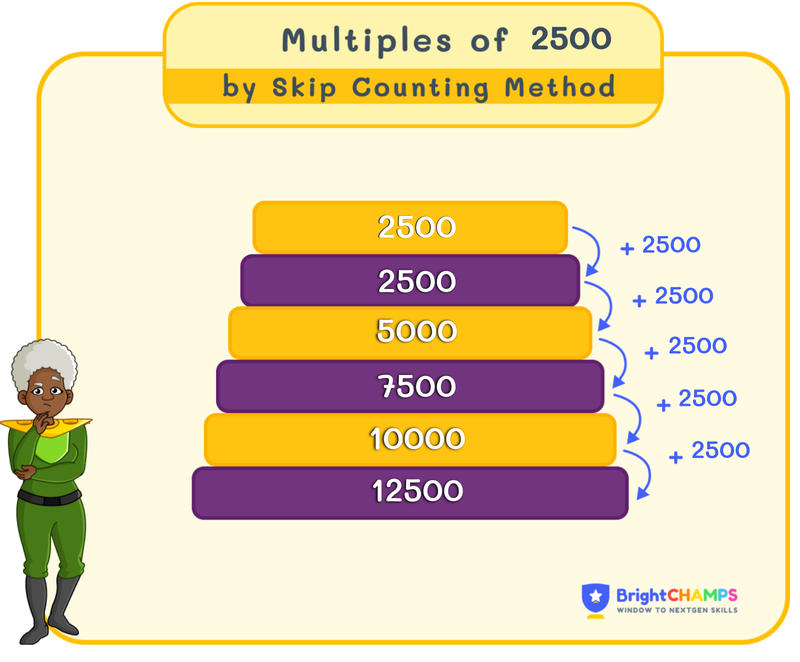
List of First 20 Multiples of 2500
Multiples of 2500 include the products of 2500 and an integer. Multiples of 2500 are divisible by 2500 evenly. The first few multiples of 2500 are given below:
| TABLE OF 2500 (1-10) | |
|---|---|
|
2500 x 1 = 2500 |
2500 x 6 = 15000 |
|
2500 x 2 = 5000 |
2500 x 7 = 17500 |
|
2500 x 3 = 7500 |
2500 x 8 = 20000 |
|
2500 x 4 = 10000 |
2500 x 9 = 22500 |
|
2500 x 5 = 12500 |
2500 x 10 = 25000 |
| TABLE OF 2500 (11-20) | |
|---|---|
|
2500 x 11 = 27500 |
2500 x 16 = 40000 |
|
2500 x 12 = 30000 |
2500 x 17 = 42500 |
|
2500 x 13 = 32500 |
2500 x 18 = 45000 |
|
2500 x 14 = 35000 |
2500 x 19 = 47500 |
|
2500 x 15 = 37500 |
2500 x 20 = 50000 |
Now, we know the first few multiples of 2500. They are 0, 2500, 5000, 7500, 10000, 12500, 15000, 17500, 20000, 22500, 25000,...
Operations with Multiples of 2500
Understanding the multiples of 2500 helps solve mathematical problems and boost our multiplication and division skills. When working with multiples of 2500, we need to apply it to different mathematical operations such as addition, subtraction, multiplication, and division.
Sum of First 5 Multiples of 2500:
2500, 5000, 7500, 10000, and 12500 are the first five multiples of 2500. When multiplying 2500 from 1 to 5 we get these numbers as the products. So, the sum of these multiples is: 2500 + 5000 + 7500 + 10000 + 12500 = 37500 When we add the first 5 multiples of 2500, the answer will be 37500.
Subtraction of First 5 Multiples of 2500:
While we do subtraction, it improves our comprehension of how the value decreases when each multiple is subtracted from the previous one. 2500, 5000, 7500, 10000, and 12500 are the first five multiples of 2500. So, let us calculate it as given below:
2500 - 5000 = -2500
-2500 - 7500 = -10000
-10000 - 10000 = -20000
-20000 - 12500 = -32500
Hence, the result of subtracting the first 5 multiples of 2500 is -32500.
Average of First 5 Multiples of 2500:
To calculate the average, we need to identify the sum of the first 5 multiples of 2500, and then divide it by the count, i.e., 5. Because there are 5 multiples presented in the calculation. Averaging helps us to understand the concepts of central tendencies and other values. We know the sum of the first 5 multiples of 2500 is 37500.
2500 + 5000 + 7500 + 10000 + 12500 = 37500
Next, divide the sum by 5: 37500 ÷ 5 = 7500
7500 is the average of the first 5 multiples of 2500.
Product of First 5 Multiples of 2500:
The product of given numbers is the result of multiplying all of them together. Here, the first 5 multiples of 2500 include: 2500, 5000, 7500, 10000, and 12500.
Now, the product of these numbers is: 2500 × 5000 × 7500 × 10000 × 12500 = 1,171,875,000,000,000,000,000
The product of the first 5 multiples of 2500 is 1,171,875,000,000,000,000,000.
Division of First 5 Multiples of 2500:
While we perform division, we get to know how many times 2500 can fit into each of the given multiples. 2500, 5000, 7500, 10000, and 12500 are the first 5 multiples of 2500.
2500 ÷ 2500 = 1
5000 ÷ 2500 = 2
7500 ÷ 2500 = 3
10000 ÷ 2500 = 4
12500 ÷ 2500 = 5
The results of dividing the first 5 multiples of 2500 are: 1, 2, 3, 4, and 5.
Explore Our Programs


Common Mistakes and How to Avoid Them in Multiples of 2500
While working with multiples of 2500, we make common mistakes. Identifying these errors and understanding how to avoid them can be helpful. Below are some frequent mistakes and tips to avoid them:
Mistake 1

Confusing Multiples with Factors

Sometimes, students get confused between the multiples and factors of 2500. A simple trick to differentiate between the two is to remember that multiples are the products of multiplication, while factors are the divisors of the number. Multiples of 2500 refer to the products we get while multiplying 2500 with other numbers. For example, multiples of 2500 include 0, 2500, 5000, 7500, 10000, 12500, 15000, 17500, 20000, 22500, 25000, etc.
The factors of 2500 include numbers such as 1, 2, 4, 5, 10, 20, 25, 50, 100, 125, 250, 500, 625, 1250, and 2500. These are the numbers that can divide 2500 without any remainder.
Mistake 2
Skipping Multiples while Listing
Be careful when listing each multiple in the sequence. Otherwise, it may lead to incorrect calculations and results. Children sometimes skip multiples when writing them. To clearly understand the issue, take a look at this:
Multiples of 2500 include 2500, 5000, 7500, 10000, 12500, 15000, …..25000, 27500,...
If children do this, they may get confused and mix up the sequential order. So, maintain a consistent order by including each multiple.
Mistake 3
Forgetting to Check the Results with Multiplication
If you are adding or subtracting multiples of 2500, the result will still be a multiple of 2500. For example, children may write,
2500 + 5000 = 7501 (which is wrong and the correct answer is 7500)
This is incorrect because 7501 is not a multiple of 2500. The same applies to subtraction. When you are adding or subtracting, ensure that the results are multiples of 2500.
Mistake 4
Ignoring the Concept of Zero
Don’t forget that zero is a multiple of every number. The very first multiple of 2500, and any other number, is zero, it has a valid value. Remember this:
2500 × 0 = 0
Mistake 5
Using Addition Instead of Multiplication
Apply multiplication for calculations and check the results for accuracy. Sometimes, children may incorrectly add 2500 + 2500 + 2500 + 2500 + 2500. Instead of adding too many values, use multiplication. Calculate 2500 × n for the nth multiple.
For example, instead of 2500 + 2500 + 2500 + 2500 + 2500, calculate it as given below:
2500 × 5 = 12500



Multiples of 2500 Examples


Problem 1
A company is planning to distribute brochures for a marketing campaign. Each batch of brochures consists of 2,500 units. If the company plans to distribute the same number of brochures every month for 6 months, how many brochures will they distribute in total?

15,000 brochures
Explanation
Brochures distributed each month = 2,500
Number of months = 6
2,500 × 6 = 15,000
They will distribute a total of 15,000 brochures over 6 months.

Problem 2
A construction project requires a specific type of brick, and each pallet holds 2,500 bricks. The first phase of the project uses 3 pallets, the second phase uses 5 pallets, and the third phase uses 7 pallets. How many bricks are used in total for all three phases?
37,500 bricks
Explanation
First phase: 2,500 × 3 = 7,500 bricks
Second phase: 2,500 × 5 = 12,500 bricks
Third phase: 2,500 × 7 = 17,500 bricks
Total bricks = 7,500 + 12,500 + 17,500 = 37,500
Therefore, a total of 37,500 bricks are used for all three phases.
Problem 3
A tech company manufactures 2,500 smartphones in each production run. If they complete 10 production runs in a month, how many smartphones will they produce in that month?
25,000 smartphones
Explanation
Number of smartphones per production run = 2,500
Number of production runs in a month = 10
2,500 × 10 = 25,000
The company will produce 25,000 smartphones in that month.
Problem 4
An artist is preparing canvases for a series of paintings. Each canvas requires 2,500 square centimeters of fabric. If the artist plans to create 8 paintings, how much fabric in total will be needed?
20,000 square centimeters
Explanation
Fabric needed per canvas = 2,500 square centimeters
Number of paintings = 8
2,500 × 8 = 20,000
The artist will need a total of 20,000 square centimeters of fabric.
Problem 5
A warehouse stores boxes of goods, where each box contains exactly 2,500 items. If the warehouse receives shipments of 4 boxes, 6 boxes, and 8 boxes on three different days, how many items are stored in total?
45,000 items
Explanation
First shipment: 2,500 × 4 = 10,000 items
Second shipment: 2,500 × 6 = 15,000 items
Third shipment: 2,500 × 8 = 20,000 items
Total items = 10,000 + 15,000 + 20,000 = 45,000
Thus, there are a total of 45,000 items stored in the warehouse.

FAQs on Multiples of 2500
1.How do you find the multiples of 2500?

2.What is the LCM of 100 and 2500?
3.What are the real-life applications of Multiples of 2500?
4.Are multiples of 2500 finite or infinite?
5.Is there any odd multiple of 2500?
Important Glossaries for Multiples of 2500
- Multiple: A multiple represents the product of a number that may be multiplied by an integer. For example, multiples of 2500 include 2500, 5000, 7500, 10000, etc.
- Number pattern: This refers to how numbers are listed. It should follow a certain sequence. Multiples of 2500 are the numbers that consist of the number pattern of 2500.
- Even number: An even number refers to any number that can be divisible by 2 without leaving any remainder. The last digits of even numbers are 0, 2, 4, 6, or 8. All multiples of 2500 are even numbers.
- Divisor: It refers to any number by which another number can be divided without leaving any remainder. 1, 2, 4, 5, 10, 20, 25, 50, 100, 125, 250, 500, 625, 1250, and 2500 are the divisors of 2500.
- LCM (Least Common Multiple): The smallest common multiple of two or more numbers. For example, the LCM of 100 and 2500 is 2500, as it is the smallest multiple common to both numbers.

More topics related to Multiples of 2500
![Important Math Links Icon]() Related calculations for Multiples of 2500
Related calculations for Multiples of 2500

![Important Math Links Icon]() Next to Multiples of 2500
Next to Multiples of 2500
![Important Math Links Icon]() Other topics in Multiplication Tables
Other topics in Multiplication Tables

Seyed Ali Fathima S
About the Author
Seyed Ali Fathima S a math expert with nearly 5 years of experience as a math teacher. From an engineer to a math teacher, shows her passion for math and teaching. She is a calculator queen, who loves tables and she turns tables to puzzles and songs.
Fun Fact
: She has songs for each table which helps her to remember the tables


