




Summarize this article:
 291 Learners
Last updated on December 16, 2025
Factors of -75

Factors are the numbers that divide any given number evenly without a remainder. In daily life, we use factors for tasks like sharing items equally, arranging things, etc. In this topic, we will learn about the factors of -75, how they are used in real life, and tips to learn them quickly.

What are the Factors of -75?
The numbers that divide -75 evenly are known as factors of -75.
A factor of -75 is a number that divides the number without a remainder.
The factors of -75 are 1, 3, 5, 15, 25, and 75.
Negative factors of -75: -1, -3, -5, -15, -25, and -75.
Prime factors of -75: 3 and 5.
Prime factorization of -75: -1 × 3 × 5².
The sum of the positive factors of 75: 1 + 3 + 5 + 15 + 25 + 75 = 124
The factors of -75 can be written as shown in the table given below:
| Factor Type | Values |
| Positive Factors of -75 | (1, 3, 5, 15, 25, 75.) |
| Negative Factors of -75 | (-1, -3, -5, -15, -25, -75) |
| Prime Factors of -75 | (3, 5) |
| Prime Factorization of -75 | -1 × 3 × 5² |
| Sum of factors of -75 | 124 |
How to Find Factors of -75?
Factors can be found using different methods. Mentioned below are some commonly used methods:
- Finding factors using multiplication
- Finding factors using the division method
- Prime factors and prime factorization
Finding Factors Using Multiplication
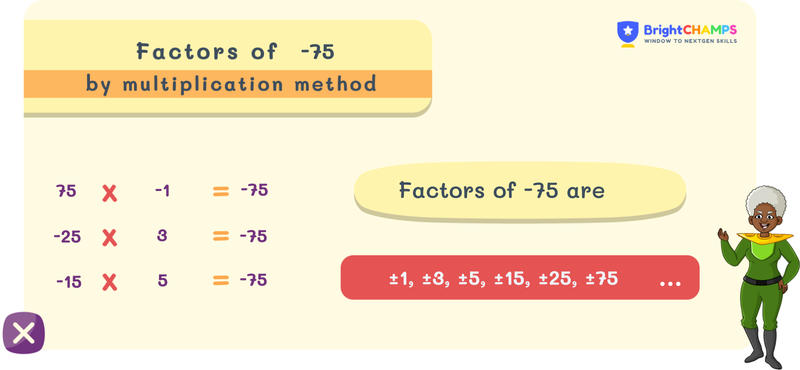
To find factors using multiplication, we need to identify the pairs of numbers that are multiplied to give -75. Identifying the numbers which are multiplied to get the number -75 is the multiplication method.
Step 1: Multiply -75 by 1, -75 × 1 = -75.
Step 2: Check for other numbers that give -75 after multiplying 3 × -25 = -75 5 × -15 = -75
Therefore, the positive factor pairs of -75 are: (1, -75), (3, -25), and (5, -15).
For every positive factor, there is a corresponding negative factor.
Explore Our Programs


Finding Factors Using Division Method
Dividing the given numbers with whole numbers until the remainder becomes zero and listing out the numbers which result in whole numbers as factors. Factors can be calculated by following a simple division method
Step 1: Divide -75 by 1, -75 ÷ 1 = -75.
Step 2: Continue dividing -75 by the numbers until the remainder becomes 0.
-75 ÷ 1 = -75
-75 ÷ 3 = -25
-75 ÷ 5 = -15
Therefore, the factors of -75 are: 1, 3, 5, 15, 25, and 75.
Prime Factors and Prime Factorization
- Multiplying prime numbers to get the given number as their product is called prime factors.
- Prime factorization is the process of breaking down the number into its prime factors.
Prime Factors of -75
Prime factors of -75 divide the number to break it down into the multiplication form of prime factors till the remainder becomes 1.
-75 ÷ -1 = 75
75 ÷ 3 = 25
25 ÷ 5 = 5
5 ÷ 5 = 1
The prime factors of -75 are 3 and 5.
Prime Factorization of -75
Prime Factorization breaks down the prime factors of -75.
Step 1: Firstly, -75 is divided by -1 to get 75.
Step 2: Now divide 75 by 3 to get 25.
Step 3: Then divide 25 by 5 to get 5. Here, 5 is a prime number that cannot be divided anymore.
So, the prime factorization of -75 is: -1 × 3 × 5².
Factor Pairs of -75
Two numbers that are multiplied to give a specific number are called factor pairs. Both positive and negative factors constitute factor pairs.
Positive factor pairs of -75:
| Factors | Positive Pair Factors |
| 1 × −75 = −75 | 1, −75 |
| 3 × −25 = −75 | 3, −25 |
| 5 × −15 = −75 | 5, −15 |
Negative factor pairs of -75:
| Factors | Negative Pair Factors |
| −1 × 75 = −75 | −1, 75 |
| −3 × 25 = −75 | −3, 25 |
| −5 × 15 = −75 | −5, 15 |

Common Mistakes and How to Avoid Them in Factors of -75
Mistakes are common while finding factors. We can identify and correct those mistakes using the following common mistakes and the ways to avoid them.
Mistake 1

Forgetting the number itself and 1 is a factor

Children might forget to add the given number itself and 1 as a factor. The number itself and 1 are the factors for every word. Always remember to include 1 and the number itself.
For example, in factors of -75, 1 and -75 are also factors.
Mistake 2
Missing Negative Factors
We often only mention positive factors. There are also negative factors, always check whether you have mentioned negative factors.
For example, the factors of -75 consist of -1, -3, -5, etc.
Mistake 3
Including the Fraction
Children might sometimes add fractions also as a factor. Only whole numbers can be a factor.
For example, thinking 1.5 as a factor because -75/1.5 = -50, and it is not a whole number.
Mistake 4
Confusing Factors With Prime Numbers
Remember that factors can be any whole numbers, not only just primes.
For example, thinking all the factors of -75 are prime numbers.
For example, 3 and 5 are the prime factors of -75, but it has other factors like 15, 25.
Mistake 5
Mistake in Factorization
Children might skip the steps in factorization and end up writing wrong factors.
For example, not breaking -75 as -1 × 3 × 5² and missing all the key factors.


Factors of -75 Examples


Problem 1
A machine needs to produce -75 parts, and it operates in cycles of 3 parts. How many cycles are required?

25 cycles are required.
Explanation
To find the number of cycles, divide the total parts by parts per cycle.
-75/(-3) = 25

Problem 2
You have -75 meters of fabric and need to cut it into pieces of 25 meters each. How many pieces can you cut?
You can cut 3 pieces.
Explanation
Dividing the total fabric by the length of each piece gives the number of pieces.
-75/25 = -3
Problem 3
A Costco store in Chicago notices a sales-tax reconciliation error after closing accounts. The system shows a −75 USD adjustment that must be split into equal whole-dollar corrections across departments. What are all the factors of −75 that represent possible equal splits?
−1, −3, −5, −15, −25, −75, 1, 3, 5, 15, 25, 75
Explanation
First find the factors of 75.
Prime factorization:
75 = 3 × 5 × 5
Using these primes, the positive factors of 75 are 1, 3, 5, 15, 25, and 75.
Because the original number is negative, each positive factor also has a negative counterpart.
Therefore, all ± divisors of 75 are factors of −75.
Problem 4
In a Miami middle-school science lab, students analyze pharmacy inventory data similar to Walgreens. A simulation shows a −75 mg correction in total medicine dosage due to an entry error. The dosage must be divided into equal integer units. Which integers are factors of −75?
−1, −3, −5, −15, −25, −75, 1, 3, 5, 15, 25, 75
Explanation
A factor is a number that divides −75 exactly with no remainder.
The number 75 has factors based on its prime factorization 3 × 5².
Since the dosage correction is negative, both positive and negative integers are valid.
This results in the full factor list of −75.
Problem 5
An NBA team in Los Angeles (LA) reviews travel expenses after a road game in San Francisco. Due to a gas-price miscalculation (per gallon), the travel log shows a −75 gallon fuel correction. The loss must be divided evenly across fuel entries. What are all the factors of −75 that allow an exact split?
−1, −3, −5, −15, −25, −75, 1, 3, 5, 15, 25, 75
Explanation
To divide −75 gallons evenly, we need integers that divide −75 without leaving a remainder.
The absolute value 75 has multiple factor pairs.
Because the total correction is negative, each positive divisor also has a corresponding negative divisor.
Thus, all ± factors of 75 are valid factors of −75.

FAQs on Factors of -75
1.What are the factors of -75?

2.Mention the prime factors of -75.
3.Is -75 a multiple of 5?
4.Mention the factor pairs of -75?
5.What is the square of -75?
6.How many factors does −75 have?
7.What is the smallest factor of −75?
8.What is the largest factor of −75?
9.Which factors of −75 add up to 13?
10.How many even factors does −75 have?
11.What are the odd factors of −75?
12.What is the sum of all the factors of −75?
Important Glossaries for Factors of -75
- Factors: The numbers that divide the given number without leaving a remainder are called factors. For example, the factors of -75 are 1, 3, 5, 15, 25, and 75.
- Prime factors: The factors which are prime numbers. For example, 3 and 5 are prime factors of -75.
- Factor pairs: Two numbers in a pair that are multiplied to give the original number are called factor pairs. For example, the factor pairs of -75 are (1, -75), (3, -25), etc.
- Prime factorization: The process of breaking down a number into its prime factors. For example, the prime factorization of -75 is -1 × 3 × 5².
- Negative factors: These are factors of a number that are negative. For example, the negative factors of -75 are -1, -3, -5, -15, -25, and -75.



Hiralee Lalitkumar Makwana
About the Author
Hiralee Lalitkumar Makwana has almost two years of teaching experience. She is a number ninja as she loves numbers. Her interest in numbers can be seen in the way she cracks math puzzles and hidden patterns.
Fun Fact
: She loves to read number jokes and games.


