Summarize this article:
 301 Learners
Last updated on August 5, 2025
Is 235 a Prime Number?


Is 235 a Prime Number?
Numbers can be categorized mainly as Prime numbers and Composite numbers, based on the number of factors.
A prime number is a natural number that is divisible only by 1 and itself.
For example, 3 is a prime number because it is divisible by 1 and 3 only.
Conversely, a composite number is a positive number that has more than two divisors.
For example, 6 is divisible by 1, 2, 3, and 6, making it a composite number.
Prime numbers have distinct properties such as:
- Prime numbers are positive numbers always greater than 1.
- 2 is the only even prime number.
- They have only two factors: 1 and the number itself.
- Any two distinct prime numbers are co-prime numbers because they have only one common factor, which is 1.
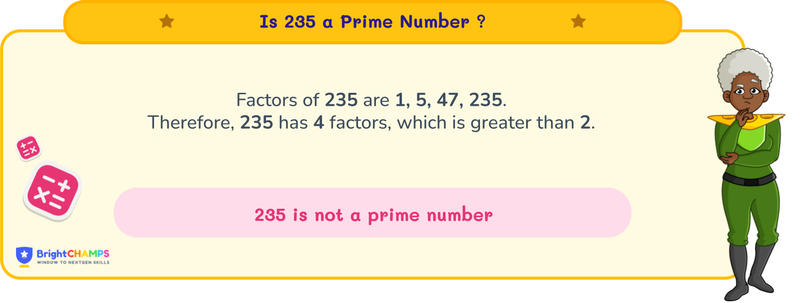
Since 235 has more than two factors, it is not a prime number.
Why is 235 Not a Prime Number?
The defining characteristic of a prime number is that it has only two divisors: 1 and itself.
Since 235 has more than two factors, it is not a prime number.
Several methods can be used to differentiate between prime and composite numbers, such as:
- Counting Divisors Method
- Divisibility Test
- Prime Number Chart
- Prime Factorization
Using the Counting Divisors Method
The counting divisors method involves counting the number of divisors to classify numbers as prime or composite.
Based on the count of the divisors, we classify numbers accordingly:
- If there is a total count of only 2 divisors, then the number is prime.
- If the count is more than 2, the number is composite.
Let’s check whether 235 is prime or composite.
Step 1: All numbers are divisible by 1 and themselves.
Step 2: Divide 235 by 2. It is not divisible by 2, as it is an odd number.
Step 3: Divide 235 by 3. The sum of the digits (2 + 3 + 5 = 10) is not divisible by 3, so 3 is not a factor.
Step 4: Divide 235 by 5. Since the last digit is 5, it is divisible by 5.
Step 5: Continue checking divisors up to the square root of 235. Since 235 has more than 2 divisors, it is a composite number.
Explore Our Programs


Using the Divisibility Test Method
We use a set of rules to check whether a number is divisible by another number completely or not. This is known as the Divisibility Test Method.
Divisibility by 2: 235 is an odd number, so it is not divisible by 2.
Divisibility by 3: The sum of the digits in 235 is 10. Since 10 is not divisible by 3, 235 is not divisible by 3.
Divisibility by 5: The unit’s place digit is 5. Therefore, 235 is divisible by 5.
Divisibility by 7: For divisibility by 7, double the last digit (5 × 2 = 10) and subtract it from the rest of the number (23 - 10 = 13). Since 13 is not divisible by 7, 235 is not divisible by 7. Since 235 is divisible by 5, it has more than two factors, making it a composite number.
Using Prime Number Chart
The prime number chart is a tool created by using a method called “The Sieve of Eratosthenes.”
In this method, we follow these steps:
Step 1: Write numbers from 1 to 100 in rows and columns.
Step 2: Leave 1 without coloring or crossing, as it is neither prime nor composite.
Step 3: Mark 2 because it is a prime number, and cross out all multiples of 2.
Step 4: Mark 3 because it is a prime number, and cross out all multiples of 3.
Step 5: Continue this process up to the prime numbers in the table. Through this method, we obtain a list of prime numbers from 1 to 100. Since 235 is not present in the list, it is a composite number.
Using the Prime Factorization Method
Prime factorization involves breaking down a number into its prime factors, and then multiplying those factors to obtain the original number.
Step 1: We can express 235 as 5 × 47.
Step 2: Both 5 and 47 are prime numbers.
Step 3: Thus, the prime factorization of 235 is 5 × 47.

Common Mistakes to Avoid When Determining if 235 is Not a Prime Number
Learners may have misunderstandings about prime numbers while studying them. Here are some common mistakes:
Mistake 1

Assuming That All Odd Numbers Are Prime

Learners might assume that all odd numbers are prime. However, they should be taught that while most prime numbers are odd, not all odd numbers are prime.
For example, 9 is an odd number but has more than two factors, making it a composite number.
Mistake 2
Confusing 1 as a Prime Number
Learners need to understand that a prime number must have exactly two factors. Since 1 has only one factor, which is itself, it is neither a prime nor a composite number.
Mistake 3
Relying Too Heavily on Memorization
Learners may depend on memorizing prime numbers, which can lead to confusion, such as remembering whether 29 or 39 is prime. They should instead understand and apply divisibility rules.
Mistake 4
Applying Divisibility Rules Incorrectly
Errors can occur when applying divisibility rules.
For example, learners may incorrectly divide 81 by 3. Understanding rules like the sum of the digits being divisible by 3 can help avoid such mistakes.
Mistake 5
Assuming That Negative Numbers Can Be Prime
Learners might wrongly assume that negative numbers can be prime. They need to know that prime numbers are positive integers greater than 1.


FAQ on is 235 a Prime Number?
1.Is 235 a perfect square?

2.What is the sum of the divisors of 235?
3.What are the factors of 235?
4.What are the closest prime numbers to 235?
5.What is the prime factorization of 235?
Important Glossaries for "Is 235 a Prime Number"
- Composite numbers: Natural numbers greater than 1 that have more than 2 divisors. For example, 12 is a composite number because it has divisors 1, 2, 3, 4, 6, and 12.
- Prime numbers: Natural numbers greater than 1 that have exactly two divisors: 1 and themselves. For example, 7 is a prime number.
- Factors: Numbers that divide another number exactly without leaving a remainder. For example, the factors of 6 are 1, 2, 3, and 6.
- Divisibility rules: Guidelines that help determine whether one number is divisible by another without performing division. For example, a number is divisible by 3 if the sum of its digits is divisible by 3.
- Prime factorization: The process of expressing a number as a product of its prime factors. For example, the prime factorization of 18 is 2 × 3 × 3.



Samia
About the Author
Samia has almost two years of teaching experience. She is a number ninja as she loves numbers. Her interest in numbers can be seen in the way she cracks math puzzles and hidden patterns.

Fun Fact
: She loves to read number jokes and games.


We use cookies for essential site function, analytics, and marketing. You can accept all, reject non-essential cookies, or customize your choices. See our Cookie Policy.