Summarize this article:
 456 Learners
Last updated on August 5, 2025
Is 1573 a prime number?


Is 1573 a prime number?
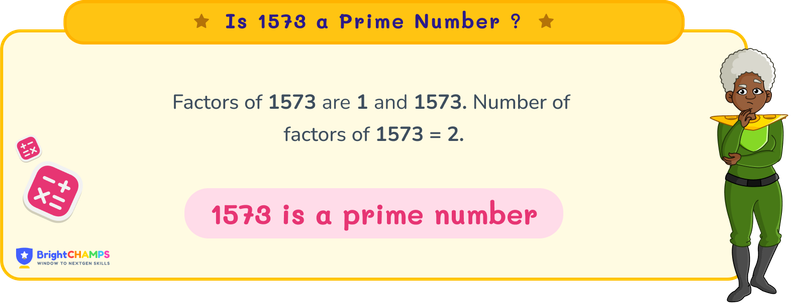
The number 1573 has got 4 factors that are capable of dividing the number completely without leaving any remainder. Thus, the number 1573 is a non-prime number. The factors of 1573 include 1, 11, 13, 121, 143 and 1573.
Why is 1573 not a prime number?
A number to be a prime number should follow the criteria that it should not have factors more than 2. Here, 1573 has more than 2 factors, hence making it a composite number.
Given below are a few ways that can be used to find prime or composite numbers.
The different methods we can use to check if a number is a prime number are explained below:
- Counting Divisors Method
- Divisibility Test
- Prime Number Chart
- Prime Factorization
Using the Counting Divisors Method
For the counting divisors method, it is to be checked whether the number is divisible by any numbers other than 1 and the number itself.
The counting divisors method for 1573 would simply be:
Divisors of 1573 = 1, 11, 13, 121, 143, 1573.
Number of divisors = 6
The number 1573 can be considered composite.
Explore Our Programs


Using the Divisibility Method
In the division test, we try to divide the number by any of the prime numbers. If we cannot, then it is considered a prime number.
In the divisibility method, the prime number only has 2 divisors, which are 1 and itself.
The divisors of 1573 are 1, 11, 13, 121, 143 and 1573.
Thus, 1573 consists of 6 factors that divide it completely without any remainder.
Using the Prime Number Chart
The prime number chart is the list of prime numbers starting from 2 to infinity.
The list of prime numbers under 100 are:
1511,1523,1531,1543,1549,1553,1559,1567,1571,1579,1583,1597,1601,1607,1609,1613,1619,1621,1627,1637,1657,1663,1667,1669,1693,1697,1699
1573 is not present in the list, it is not a prime number.
Using the Prime Factorization
This method is only used for a non-prime number/composite number. Since 1573 is a composite number, the prime factorization for 1573 is:
Factors of 1573 = 11 × 11 × 13

Common mistakes to avoid when determining if 1573 is a prime number
It is highly likely we commit some mistakes due to confusion or unclear understanding. Let us look at possible mistakes we may make and try to avoid them.
Mistake 1

Misinterpreting all numbers to be prime.

A number being odd does not decide if the number will be prime. An odd number can also be a composite number.
Mistake 2
Skipping out the divisors
Without checking all the divisors of a number, students incorrectly conclude a number is prime or composite. Avoid doing this
Mistake 3
Thinking prime numbers should fall in a range only
Prime numbers do not have a range. As long as the criteria of having 2 divisors is fulfilled, the prime number can be any number.
Mistake 4
Overlooking higher divisors
When checking divisibility, students may stop at smaller numbers. To properly determine primality, check divisibility up to the square root of the number.
Mistake 5
Forgetting to test divisibility by prime numbers
Testing divisibility only by small numbers or skipping prime numbers like 2, 3, 5, 7, etc., can lead to incorrect conclusions. Always test divisibility by prime numbers up to the square root of the given number.


FAQs for "Is 1573 a prime number"
1.Is 1573 a prime number?

2.What is the smallest prime factor of 1573?
3.What is the largest prime factor of 1573?
4.Is 1573 a composite number?
5.How to express 1573 as a product of prime factors?
6.Represent 1573 in the prime factor tree?
7.Do any perfect squares exist in the prime factors of 1573?
8.Do any perfect cubes exist in the prime factors of 1573?
9.What can 1573 be divided by?
Glossary for "Is 1573 a Prime Number?"
Prime Number: A natural number greater than 1 that has no divisors other than 1 and itself. For example, 2, 3, and 5 are prime numbers.
Composite Number: A natural number greater than 1 that has more than two divisors. For example, 4, 6, and 8 are composite numbers, as they have divisors other than 1 and the number itself.
Divisibility: The ability of one number to be divided by another without leaving a remainder. For example, 1573 is divisible by 11 and 13.
Prime Factorization: Breaking down a composite number into the product of prime numbers. The prime factorization of 1573 is 11 × 11 × 13.
Divisors: Numbers that can divide another number without leaving a remainder. The divisors of 1573 are 1, 11, 13, 121, 143 and 1573.


Samia
About the Author
Samia has almost two years of teaching experience. She is a number ninja as she loves numbers. Her interest in numbers can be seen in the way she cracks math puzzles and hidden patterns.

Fun Fact
: She loves to read number jokes and games.


We use cookies for essential site function, analytics, and marketing. You can accept all, reject non-essential cookies, or customize your choices. See our Cookie Policy.