Summarize this article:
 343 Learners
Last updated on August 5, 2025
27/16 as a Decimal


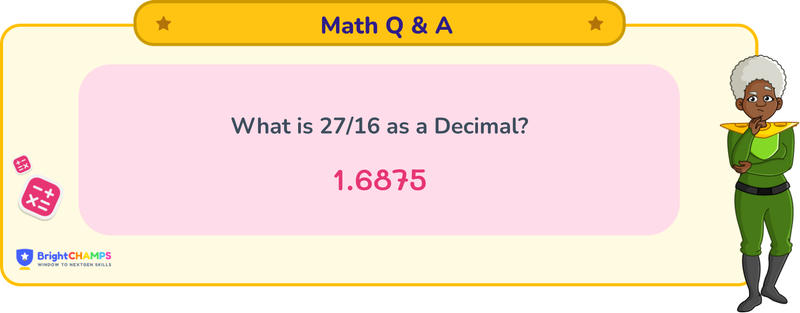
What is 27/16 as a decimal?
Answer
27/16 in decimals can be written as 1.6875. It is a terminating decimal, meaning it does not repeat infinitely.
Explanation
To get 27/16 in decimal, we will use the division method. Here, 27 is larger than 16, so we can proceed directly with the division. Let's see the step-by-step breakdown of the process:
Step 1: Identify the numerator and denominator because the numerator (27) will be taken as the dividend and the denominator (16) will be taken as the divisor.
Step 2: Divide 27 by 16. 16 goes into 27 one time. Place 1 in the quotient place. Multiply 1 by 16, which gives 16. Subtract 16 from 27, leaving a remainder of 11.
Step 3: Bring down a 0, making it 110. Divide 110 by 16. 16 goes into 110 six times. Place 6 in the quotient after the decimal point. Multiply 6 by 16, which gives 96. Subtract 96 from 110, leaving a remainder of 14.
Step 4: Bring down another 0, making it 140. Divide 140 by 16. 16 goes into 140 eight times. Place 8 in the quotient. Multiply 8 by 16, which gives 128. Subtract 128 from 140, leaving a remainder of 12.
Step 5: Bring down another 0, making it 120. Divide 120 by 16. 16 goes into 120 seven times. Place 7 in the quotient. Multiply 7 by 16, which gives 112. Subtract 112 from 120, leaving a remainder of 8.
Step 6: Bring down another 0, making it 80. Divide 80 by 16. 16 goes into 80 five times. Place 5 in the quotient. Multiply 5 by 16, which gives 80, leaving a remainder of 0.
The division process concludes as we reach a remainder of 0, showing 27/16 as a decimal is 1.6875.
Important Glossaries for 27/16 as a decimal
- Fraction: A numerical quantity that is not a whole number, representing a part of a whole.
- Decimal: A number that uses the base ten and includes a decimal point to separate the whole part from the fractional part.
- Numerator: The top part of a fraction, indicating how many parts of the whole are being considered.
- Denominator: The bottom part of a fraction, showing how many parts make up a whole.
- Terminating Decimal: A decimal that ends and does not repeat infinitely.


We use cookies for essential site function, analytics, and marketing. You can accept all, reject non-essential cookies, or customize your choices. See our Cookie Policy.